I ran a few more numbers for the finals again Japan and I thought I would share them
Point distribution among players wasn't as flat as I would like. Two players only played 3 points, while four players played 10+. The ramp between those two levels was pretty even, but I wish playing time was a little more even. It is a difficult ask as those sort of things tend to fall away in the finals and during a tournament when there are many ofter things going on.
Possessions per goal for each team were decent, but not excellent. USX needed (on average) 2.77 possessions to score and Japan needed 3.18. It is always true that the team with the lower number during a game wins, so there isn't much behind a comparison of these numbers. Comparing it to previous college and club teams it falls within the range of expectation for college teams (where playing 2 is elite college and 3+ isn't unheard of) and I wouldn't expect to be at the front of that number since there isn't a ton of time to gel and the competition is better. It is pretty bad for a club team, although I haven't looked at those numbers for the mixed division in particular.
The number that is most interesting to me is percentage of possessions ending in an unforced error (defense doesn't touch the disc). USX had consistent numbers in the first and second half around 43-45%, which again isn't that bad (but could really be a lot better). The impressive thing for me is that in the 2nd half Japan had a number of 21.4% That is very elite. That means 1 out of every 5 possessions ends in an unforced error (which includes hucks that go too far). If a team I am coaching has that number then we are either winning, both teams are playing lights out, or they are getting blocks. The latter was the case this time, as we were able to slightly grow a lead despite the Japanese playing relatively error free ultimate.
Saturday, January 27, 2018


Wednesday, January 24, 2018
Gender Contact Ratio (3rd cycle)
This past January I was fortunate enough to have another wonderful experience coaching the USA U24 Mixed team (USX). We won a gold medal, like the previous two years, but this cycle was very different from the past two.
This was the first iteration with no founding players. Last cycle we had returners that had shaped the teams existence and this was the first official passing of a torch to new leaders for whom this was already an "established" thing. This time we took a smaller roster, slightly eschewing the "more people means more fun" mentality for the possibility of a tighter knit team. This cycle also was captive by the times and far more interested in gender equity than teams in the past. All of these things are probably worth talking about at some point, but for now we will divert from the last one to look at the same thing I have looked at the past two, gender contact ratio.
The same caveat applies as before: there isn't a "perfect" number that represents the most "equitable" style of play. We can't make hard conclusions about the involvement of both genders from this number, but it does help us check our perception of reality and talk about broad topics.
The context of the game was similar to last cycle. It was windy, but not too oppressive. Japan used their women more effectively (at least in my opinion) than Australia did in 2015. Our team was more conscientious about using our women, and we had more female handlers than we had ever had. In 2013 we could argue having 3 female handlers, with really only Sophie being a true center handler in the bunch. This group decided early on that we had really good female center handlers and threw the first pass to them without any instruction from us. This time we had Hardy, KJ, T-Lo and Anna all acting as handlers and all taking turns getting centered to. Japan also utilized a zone that required a lot of patty-cake from our handlers (or maybe it was the handlers that we had at the time) because we weren't going to swing around their 3-3-1 as easily. This patty-cake often featured male handlers getting lots of touches.
The numbers for this game were pretty surprising. I felt like we were more equitable with our distribution, not as a mantra but rather because we were opening up good space and willing to throw passes. I often talk about how my anecdotal measure of success for a mixed team is how willing they are to throw a 20-30 yard under to a woman who is well guarded. It shows a level of trust, openness of space, and also a recognition that small spaces are ok sometimes. I felt like this team leaned in to that principle well and was often throwing big gainers to their women. Those women didn't turn around and boost it as much as I would like, but at the same time they weren't always resetting the disc either, so I think it is a structural problem in how we were running the offense.
To the numbers. In this game there were a total of 417 touches (as compared to 252 and 180 in the past two cycles . . . patty-cake). Of those 417, 157 were by women. This breaks down to 37.6% of the touches or a contact ratio of 1.66 times as many touches for a man as compared to a woman. If we look at the past two cycles we had numbers of 3.00 (2015) and 2.53 (2013). I know I said that this number doesn't well correlate with better play, but I can't help but feel that we threw to women more often and this number supports it. No doubt part of it is getting people in places to shine, but we were consistently throwing difficult passes to small windows and hitting women. We also did a better job of clearing out space downfield so that strings of female passes could occur before a male defender and offender crowded the picture.
It is worth noting that these numbers include a few points against that Japanese zone where we had a high number of touches and since much of that was between three men (Brett, John and Matt) it skews the numbers a bit. Women were still key players in those points, but not in the patty-cake that was most of the touches and rather in the key outlet and through passes that actually moved the disc. One such possession had 27 touches by women as compared to 52 touches by men. Another was 18/47, respectively. I thought about taking these points out, but they are real points that affected touches, so I felt they should stay in.
On thing that is worth looking at is a comparison of the final to the semi-final. After the semi against Canada there was a clear feeling by members of the team that we "hadn't used our women well." While that is amorphous and certainly isn't completely embodied by this ratio, it was the feeling by the players and we were a little surprised. Looking back at the film the first time it felt like there were plenty of places where only men were touching the disc, but that it was largely a structural issue (cutters too far away and reset defenders able to get too close) than a broader failure to throw to women. Watching the film again looking at contact ratio, the semifinal was less balanced than the final (showing that we cleaned things up) but not terribly so. The ratio was 2.24 touch for men for each by a woman. That is better than both other finals, although it is markedly worse than our final this cycle.
So what does this mean? I feel like I got this job in part because I was able to well describe a way that I thought we could best showcase mixed ultimate, not by ignoring gender and treating everyone the same, nor by over leveraging particular advantages (see Bad Larry mid2000s who ran 4 women so their men had more room to homey) but by saying that if we put people in the right places and throw to them in a system that creates space for everyone, we can all get better. It is a "total is greater than the sum of the pieces" approach. I feel like we did that in the past, and while watching these two games again more critically I do feel that we made many refinement errors (didn't run our redzone particularly well, suffered from handler creep, etc.) we did a better job of getting everyone space at times and throwing passes to everyone. That, combined with a better balance of genders in each position, and a focus on gender equity, is likely part of the reason we ended up getting more people involved.
Again, that doesn't mean that the road to victory is having a ratio of 1, or that this is the only way to win these games. But as a person who hopes to live up to values of inclusion, and recognizes that there are times that I fail, looking at the Gender Contact Ratio for this cycle makes me think that we did a pretty good job.
This was the first iteration with no founding players. Last cycle we had returners that had shaped the teams existence and this was the first official passing of a torch to new leaders for whom this was already an "established" thing. This time we took a smaller roster, slightly eschewing the "more people means more fun" mentality for the possibility of a tighter knit team. This cycle also was captive by the times and far more interested in gender equity than teams in the past. All of these things are probably worth talking about at some point, but for now we will divert from the last one to look at the same thing I have looked at the past two, gender contact ratio.
The same caveat applies as before: there isn't a "perfect" number that represents the most "equitable" style of play. We can't make hard conclusions about the involvement of both genders from this number, but it does help us check our perception of reality and talk about broad topics.
The context of the game was similar to last cycle. It was windy, but not too oppressive. Japan used their women more effectively (at least in my opinion) than Australia did in 2015. Our team was more conscientious about using our women, and we had more female handlers than we had ever had. In 2013 we could argue having 3 female handlers, with really only Sophie being a true center handler in the bunch. This group decided early on that we had really good female center handlers and threw the first pass to them without any instruction from us. This time we had Hardy, KJ, T-Lo and Anna all acting as handlers and all taking turns getting centered to. Japan also utilized a zone that required a lot of patty-cake from our handlers (or maybe it was the handlers that we had at the time) because we weren't going to swing around their 3-3-1 as easily. This patty-cake often featured male handlers getting lots of touches.
The numbers for this game were pretty surprising. I felt like we were more equitable with our distribution, not as a mantra but rather because we were opening up good space and willing to throw passes. I often talk about how my anecdotal measure of success for a mixed team is how willing they are to throw a 20-30 yard under to a woman who is well guarded. It shows a level of trust, openness of space, and also a recognition that small spaces are ok sometimes. I felt like this team leaned in to that principle well and was often throwing big gainers to their women. Those women didn't turn around and boost it as much as I would like, but at the same time they weren't always resetting the disc either, so I think it is a structural problem in how we were running the offense.
To the numbers. In this game there were a total of 417 touches (as compared to 252 and 180 in the past two cycles . . . patty-cake). Of those 417, 157 were by women. This breaks down to 37.6% of the touches or a contact ratio of 1.66 times as many touches for a man as compared to a woman. If we look at the past two cycles we had numbers of 3.00 (2015) and 2.53 (2013). I know I said that this number doesn't well correlate with better play, but I can't help but feel that we threw to women more often and this number supports it. No doubt part of it is getting people in places to shine, but we were consistently throwing difficult passes to small windows and hitting women. We also did a better job of clearing out space downfield so that strings of female passes could occur before a male defender and offender crowded the picture.
It is worth noting that these numbers include a few points against that Japanese zone where we had a high number of touches and since much of that was between three men (Brett, John and Matt) it skews the numbers a bit. Women were still key players in those points, but not in the patty-cake that was most of the touches and rather in the key outlet and through passes that actually moved the disc. One such possession had 27 touches by women as compared to 52 touches by men. Another was 18/47, respectively. I thought about taking these points out, but they are real points that affected touches, so I felt they should stay in.
On thing that is worth looking at is a comparison of the final to the semi-final. After the semi against Canada there was a clear feeling by members of the team that we "hadn't used our women well." While that is amorphous and certainly isn't completely embodied by this ratio, it was the feeling by the players and we were a little surprised. Looking back at the film the first time it felt like there were plenty of places where only men were touching the disc, but that it was largely a structural issue (cutters too far away and reset defenders able to get too close) than a broader failure to throw to women. Watching the film again looking at contact ratio, the semifinal was less balanced than the final (showing that we cleaned things up) but not terribly so. The ratio was 2.24 touch for men for each by a woman. That is better than both other finals, although it is markedly worse than our final this cycle.
So what does this mean? I feel like I got this job in part because I was able to well describe a way that I thought we could best showcase mixed ultimate, not by ignoring gender and treating everyone the same, nor by over leveraging particular advantages (see Bad Larry mid2000s who ran 4 women so their men had more room to homey) but by saying that if we put people in the right places and throw to them in a system that creates space for everyone, we can all get better. It is a "total is greater than the sum of the pieces" approach. I feel like we did that in the past, and while watching these two games again more critically I do feel that we made many refinement errors (didn't run our redzone particularly well, suffered from handler creep, etc.) we did a better job of getting everyone space at times and throwing passes to everyone. That, combined with a better balance of genders in each position, and a focus on gender equity, is likely part of the reason we ended up getting more people involved.
Again, that doesn't mean that the road to victory is having a ratio of 1, or that this is the only way to win these games. But as a person who hopes to live up to values of inclusion, and recognizes that there are times that I fail, looking at the Gender Contact Ratio for this cycle makes me think that we did a pretty good job.
Saturday, August 05, 2017
US Open 2017: Brute Squad vs. Revolution
I got a chance to watch the live stream of this excellent game between two great teams. There was a lot of hype about how this might be a bracket game at worlds next summer, and that Maddy Frey can't seem to catch the disc standing up. But I wanted to talk a bit about the strategy of the game, and in particular how I think Revolution might be changing the direction of women's ultimate in the next few years.
One key element in this discussion is that Revolution is athletic to the point the Brute Squad didn't have a decisive advantage . . . at least that is what listening to the commentators you might think. I think Brute is actually more athletic from top to bottom, but Revolution employs a style of defense that highly leverage their athletes in a way that Brute doesn't. So it doesn't matter that Brute can trot out Becky, Kami and Lien when Mosquera can guard all three with the way they play defense.
On its face, Columbia does and excellent job poaching, leaving Mosquera to guard the deep space while other cutter defenders only chase a woman deep for two strides before breaking off and finding a new threat to take. That isn't really new. What is new, and what warrants further analysis is the success that Revolution has with it against even the best teams in the world.
There are times when the defenders are super close, especially on handlers, and then there are times when offenders are wide open. Normally, when we see US and Canadian teams try this there is a failure point where the poached player gets the disc and it starts to crumble. But that doesn't seem to happen against Revolution. It only marginally happened against Columbia in the World Games final (and didn't happen in the pool play game where Columbia beat the US).
What is new about their defense is the success rate they have of not losing track of a player in a good space. Revolution, whether by practice or just something innate, is super efficient at making their switches, knowing when to stay and when to leave, and being ready to explode to get the D at the right time. It must be a nightmare for opposing offenses because it feels like offensive cadence is broken.
Like I said, this warrants more analysis. It could be that the solution is easy and this defense falls into the category of the Japanese no-mark zone where it is potentially difficult unless you have a plan. But it also could be that this defense has more merit than a one off and more teams start to implement not just the general structure of the defense (most elite teams have a poachy look to throw at out, at least to mess up your pull play) but tunnel down and figure out the principles of the defense.
Then again, it could just be that Revolution is so athletic that this works and when you try it with your club team it doesn't. It would be interesting to see something like this tried on the men's side of things, since we have good examples in both women's and mixed. But, like I said, this warrants more analysis. Stay tuned and we'll see what comes up.
One key element in this discussion is that Revolution is athletic to the point the Brute Squad didn't have a decisive advantage . . . at least that is what listening to the commentators you might think. I think Brute is actually more athletic from top to bottom, but Revolution employs a style of defense that highly leverage their athletes in a way that Brute doesn't. So it doesn't matter that Brute can trot out Becky, Kami and Lien when Mosquera can guard all three with the way they play defense.
On its face, Columbia does and excellent job poaching, leaving Mosquera to guard the deep space while other cutter defenders only chase a woman deep for two strides before breaking off and finding a new threat to take. That isn't really new. What is new, and what warrants further analysis is the success that Revolution has with it against even the best teams in the world.
There are times when the defenders are super close, especially on handlers, and then there are times when offenders are wide open. Normally, when we see US and Canadian teams try this there is a failure point where the poached player gets the disc and it starts to crumble. But that doesn't seem to happen against Revolution. It only marginally happened against Columbia in the World Games final (and didn't happen in the pool play game where Columbia beat the US).
What is new about their defense is the success rate they have of not losing track of a player in a good space. Revolution, whether by practice or just something innate, is super efficient at making their switches, knowing when to stay and when to leave, and being ready to explode to get the D at the right time. It must be a nightmare for opposing offenses because it feels like offensive cadence is broken.
Like I said, this warrants more analysis. It could be that the solution is easy and this defense falls into the category of the Japanese no-mark zone where it is potentially difficult unless you have a plan. But it also could be that this defense has more merit than a one off and more teams start to implement not just the general structure of the defense (most elite teams have a poachy look to throw at out, at least to mess up your pull play) but tunnel down and figure out the principles of the defense.
Then again, it could just be that Revolution is so athletic that this works and when you try it with your club team it doesn't. It would be interesting to see something like this tried on the men's side of things, since we have good examples in both women's and mixed. But, like I said, this warrants more analysis. Stay tuned and we'll see what comes up.
Friday, June 24, 2016
Stupid Games (part 3: Frisketball)
I have been playing Frisketball since 2011 when a bunch of Paideia Juniors and I made it up after our season ended in the spring. We could only get a handful of people, and didn't want to drive out to a field or put on cleats. So we needed something akin to pickup basketball where you could almost always play (on the same field) and people could come and go with little disturbance to the overall game. Frisketball was created and is best played with between 4 and 8 players.
The rules started almost identical to Hot Box. The playing field is the basketball court. The goal is to complete a pass to your team inside of the paint. That is it. Super simple.
In the past few years we have evolved the rules a little bit, making the game more like basketball and finding other tweaks. Here are the basic rules that we always play with.
- Stall is 7
- Picks are discouraged, but so is calling picks
- Neither offense nor defense can stand in the paint for more than 3 seconds
- If you throw the disc in the hoop it is a goal (good luck)
- Double-teams are allowed
The game is all about shifting spaces and the rectangular nature of the goal makes scoring interesting. It is a game that encourages fast play, creative throws, and offering appropriate help defense.
A 2-on-2 game is hard because the defense will always play towards the paint and with only one other person as a viable target it becomes difficult to find useful attacking space (but there is plenty of reset space).
A 3-on-3 game is exciting because there can be lots of swinging to shift attack angles, but there still aren't enough people for you to rest too much.
A 4-on-4 game is tough because the defense can clog so effectively. The offense needs to be much more coordinated, which can be very rewarding.
The game can also be full or half-court depending on numbers and available space.
A few of the alternate rules that we have installed in the game:
- No over-and-back: in a full court game once the thrower establish one point of contact beyond the half-court line if they go backwards (either with a pivot or a pass), it is a turnover.
- Out of bounds: if any point of contact for the thrower is on or beyond the out of bounds line it is a turnover. This includes stopping with the disc after you catch it (it also creates interesting trap situations on defense).
- 10 second rule: in a full court game the offensive team has 10 seconds (from in-bounds possession of the disc) to get the disc past the half-court line. This 10 seconds can be counted by anyone on or off the field, and must be counted down from 10 to avoid confusion with the stall
- 2 point line: in a full court game, if a goal is thrown from beyond the half-court line it is worth two points
- Jump ball: in a full court game, to start the game you can have a jump ball at center court. If the disc hits the ground without being caught then the team going away from the side where it lands starts with the disc at its current location.
Frisketball is really tremendous fun. People who are bad at ultimate can still be good at frisketball. It is easy to play with all ages and across gender. It isn't a lot of running, but is incredibly tiring. It can be physical or gentle depending on how you want to play it. If you give it a go and have feedback please don't hesitate to post it as a comment. All of those expanded rules were the rules of just having fun with it, so more collaboration is encouraged.
The rules started almost identical to Hot Box. The playing field is the basketball court. The goal is to complete a pass to your team inside of the paint. That is it. Super simple.
In the past few years we have evolved the rules a little bit, making the game more like basketball and finding other tweaks. Here are the basic rules that we always play with.
- Stall is 7
- Picks are discouraged, but so is calling picks
- Neither offense nor defense can stand in the paint for more than 3 seconds
- If you throw the disc in the hoop it is a goal (good luck)
- Double-teams are allowed
The game is all about shifting spaces and the rectangular nature of the goal makes scoring interesting. It is a game that encourages fast play, creative throws, and offering appropriate help defense.
A 2-on-2 game is hard because the defense will always play towards the paint and with only one other person as a viable target it becomes difficult to find useful attacking space (but there is plenty of reset space).
A 3-on-3 game is exciting because there can be lots of swinging to shift attack angles, but there still aren't enough people for you to rest too much.
A 4-on-4 game is tough because the defense can clog so effectively. The offense needs to be much more coordinated, which can be very rewarding.
The game can also be full or half-court depending on numbers and available space.
A few of the alternate rules that we have installed in the game:
- No over-and-back: in a full court game once the thrower establish one point of contact beyond the half-court line if they go backwards (either with a pivot or a pass), it is a turnover.
- Out of bounds: if any point of contact for the thrower is on or beyond the out of bounds line it is a turnover. This includes stopping with the disc after you catch it (it also creates interesting trap situations on defense).
- 10 second rule: in a full court game the offensive team has 10 seconds (from in-bounds possession of the disc) to get the disc past the half-court line. This 10 seconds can be counted by anyone on or off the field, and must be counted down from 10 to avoid confusion with the stall
- 2 point line: in a full court game, if a goal is thrown from beyond the half-court line it is worth two points
- Jump ball: in a full court game, to start the game you can have a jump ball at center court. If the disc hits the ground without being caught then the team going away from the side where it lands starts with the disc at its current location.
Frisketball is really tremendous fun. People who are bad at ultimate can still be good at frisketball. It is easy to play with all ages and across gender. It isn't a lot of running, but is incredibly tiring. It can be physical or gentle depending on how you want to play it. If you give it a go and have feedback please don't hesitate to post it as a comment. All of those expanded rules were the rules of just having fun with it, so more collaboration is encouraged.
Wednesday, June 01, 2016
Stupid Games (part 2: BruteBall?)
Ok, I've got a few tweaks to scrimmages lined up, but since it has been almost a month since my last post I'll go with something that is more unique. I cannot claim credit for this game. At best I could give credit to Noah Cohen, but I think he learned it from someone in North Carolina. Patrick Hard went to school in NC, so let's pretend he invented it.
The game's name is still up in the air. Noah called it "honey pot" . . . I am not calling a game that I might be teaching middle school kids by that name. From now on I will refer to it as BruteBall (please someone leave a better name in the comments).
The game feels similar to KanJam in that there is a can (in this case a larger, circular trashcan). But unlike KanJam it isn't a passive game about throwing and deflection. It also isn't symmetric. The game is played with exactly 3 players. Each possession two are on offense and one is on defense. The offenders are trying to put the disc in the trashcan in pretty much any manner they can, but the disc can't cross the plane at the top of the lid while it is still in someone's hand. So you literally can't jam the can.
Like ultimate, you can't travel when you have the disc and you have a stall (in this case 6 seconds). But unlike ultimate, the defender doesn't have to mark in order to stall. You would think that scoring happens when the offense puts the disc in the can, but that isn't the case. Each possession, a point is scored for the defender if there is a turnover. Then the defender rotates to a new person and you start a new possession. The only rules for the defender are they they cannot cover the can with their body/arms. Games are played to whatever you like, but 5 seems to work pretty well.
To start a possession the defender just tosses the disc somewhere in the playing area and the game starts. The playing area can be as large as you like, but must completely surround the can. It doesn't have to be a circle where the can is the center, but the can needs to be accessible from all sides.
So what is this game about. It might seem like the thing to do defensively is to just sit at the can. There are no rules preventing you from doing that, but it will allow the offense to get really close to the can, and then it only takes the offender getting the disc around your body and dropping it in to score. You might logically think that the thing to do is to stall while playing tight defense on the other offender. But then you leave an uncontested throw for on offender and if the other one sneaks past you then it is an easy goal.
Instead the thing to do is to figure out the balance between the two. You play the lane to block a direct shot while trying to also contest a pass to the other offender, all while stalling. So this game is working on help defense and controlling angles (I guess . . . it is mostly just fun).
That is it for another installment of Stupid Games. I'll come back next month with something else . . . maybe with pictures.
The game's name is still up in the air. Noah called it "honey pot" . . . I am not calling a game that I might be teaching middle school kids by that name. From now on I will refer to it as BruteBall (please someone leave a better name in the comments).
The game feels similar to KanJam in that there is a can (in this case a larger, circular trashcan). But unlike KanJam it isn't a passive game about throwing and deflection. It also isn't symmetric. The game is played with exactly 3 players. Each possession two are on offense and one is on defense. The offenders are trying to put the disc in the trashcan in pretty much any manner they can, but the disc can't cross the plane at the top of the lid while it is still in someone's hand. So you literally can't jam the can.
Like ultimate, you can't travel when you have the disc and you have a stall (in this case 6 seconds). But unlike ultimate, the defender doesn't have to mark in order to stall. You would think that scoring happens when the offense puts the disc in the can, but that isn't the case. Each possession, a point is scored for the defender if there is a turnover. Then the defender rotates to a new person and you start a new possession. The only rules for the defender are they they cannot cover the can with their body/arms. Games are played to whatever you like, but 5 seems to work pretty well.
To start a possession the defender just tosses the disc somewhere in the playing area and the game starts. The playing area can be as large as you like, but must completely surround the can. It doesn't have to be a circle where the can is the center, but the can needs to be accessible from all sides.
So what is this game about. It might seem like the thing to do defensively is to just sit at the can. There are no rules preventing you from doing that, but it will allow the offense to get really close to the can, and then it only takes the offender getting the disc around your body and dropping it in to score. You might logically think that the thing to do is to stall while playing tight defense on the other offender. But then you leave an uncontested throw for on offender and if the other one sneaks past you then it is an easy goal.
Instead the thing to do is to figure out the balance between the two. You play the lane to block a direct shot while trying to also contest a pass to the other offender, all while stalling. So this game is working on help defense and controlling angles (I guess . . . it is mostly just fun).
That is it for another installment of Stupid Games. I'll come back next month with something else . . . maybe with pictures.
Wednesday, May 04, 2016
Stupid Games (part 1: 4v6)
I wonder how many multi-part posts I can start before I finish any of them?
I like playing games, and I like making games. It is one of the things that I really enjoy about coaching. Finding the right tweak or an existing drill (or whole-cloth new drill) to teach the specific thing you are trying to get at is a ton of fun.
One game that we created is called 4v6. I'd make a diagram of it, but the diagram is incredibly boring. 4v6 is played in a box of four cones approximately 10yds by 12 yds. The team of six is on "offense" and is simply trying to keep the disc alive (no turnovers). The team of four is on "defense" and is trying to generate as many turns as possible. The game is played for a short amount of time (5 minutes) where the offensive team is always on offense. In the event of a turn, the disc goes back to the offensive team. The defense scores one point for each turnover. After the 5 minutes is over the two teams switch and the second defensive team tries to beat the first defensive team's score.
The stall is 5, but you don't have to be marking to stall the person with the disc. All offensive players must have one point of contact with the ground at all times. This basically means no running or jumping. The defensive team does not have this restriction. This really helps because the defensive team can "guard" four of the five non-throwing offensive players and can run to get the fifth.
A few other rules/tweaks we have tried:
-Have two teams of four and keep two people as permanent offense.
-No patty-cake rules where you can't throw back to the person who threw to you unless the count is over three (basically no back and forth with another player)
-Changing the size of the box. This really matters depending on disc-skill and athleticism. With Chain I had to use a larger box because the defenders were so fast.
-Changing the number of players. Really the game should be called "N+2" because the offense should always have two extra players. That means the defense can't shut down everyone and has to work together to cover the extra open offender.
If anyone still reads this blog and has questions, comments or suggestions about this game please don't hesitate to leave them below. 4v6 is far from perfect, but it does work on some good ultimate skills in a focused fashion.
I like playing games, and I like making games. It is one of the things that I really enjoy about coaching. Finding the right tweak or an existing drill (or whole-cloth new drill) to teach the specific thing you are trying to get at is a ton of fun.
One game that we created is called 4v6. I'd make a diagram of it, but the diagram is incredibly boring. 4v6 is played in a box of four cones approximately 10yds by 12 yds. The team of six is on "offense" and is simply trying to keep the disc alive (no turnovers). The team of four is on "defense" and is trying to generate as many turns as possible. The game is played for a short amount of time (5 minutes) where the offensive team is always on offense. In the event of a turn, the disc goes back to the offensive team. The defense scores one point for each turnover. After the 5 minutes is over the two teams switch and the second defensive team tries to beat the first defensive team's score.
The stall is 5, but you don't have to be marking to stall the person with the disc. All offensive players must have one point of contact with the ground at all times. This basically means no running or jumping. The defensive team does not have this restriction. This really helps because the defensive team can "guard" four of the five non-throwing offensive players and can run to get the fifth.
A few other rules/tweaks we have tried:
-Have two teams of four and keep two people as permanent offense.
-No patty-cake rules where you can't throw back to the person who threw to you unless the count is over three (basically no back and forth with another player)
-Changing the size of the box. This really matters depending on disc-skill and athleticism. With Chain I had to use a larger box because the defenders were so fast.
-Changing the number of players. Really the game should be called "N+2" because the offense should always have two extra players. That means the defense can't shut down everyone and has to work together to cover the extra open offender.
If anyone still reads this blog and has questions, comments or suggestions about this game please don't hesitate to leave them below. 4v6 is far from perfect, but it does work on some good ultimate skills in a focused fashion.
Saturday, April 30, 2016
Statistics Update, and a note on subbing patterns
I really should be working on the cutting tree, but with my coaching future in question and the high school season in full swing I have tabled that to work on some other things.
I have continued collecting data on what I think is are some novel statistics. After a year of tracking these things, I have actually gotten a somewhat reasonable set of data and I feel like conclusions can start to be made.
The first one I've talked about before: it is percentage of possessions that result in an unforced error (%UE). Conceptually this is "bad," but not necessarily directly correlated with score. In a windy game the %UE might go up very high, even if the teams are really good. Unlike "breaks" or "offensive efficiency," you can lose a game where you have a better %UE. Categorizing %UE is a little subjective, but I have been using the rule of if the defense gets a hand on it then it was "forced." Everything else falls in "unforced" and is counted. Paideia's average %UE for the season so far is ~47%, which is pretty good. Basically we give up the frisbee just under half of the time we have it . . . sounds bad, but when compared to individual games where the number is 60+% this is fine.
Since I had enough data to try this, I have wondered what this does correlate with. Anecdotally we would assume that this correlates with wins because the lower your %UE the less you are "screwing up." But I decided to take it one step farther and run a correlation with the final point differential of the game. As I get more games I have been updating the data, and it currently has an R^2 value of 0.385. Honestly I don't know if that is "good," and everything I read tells me that just looking at the R^2 value isn't enough to deem good or bad anyway. But the important thing that I note is how that number goes up. In general, aside from the data collected at a windy tournament, the correlation coefficient is getting larger as I enter more games and we play in more tournaments. I'll keep taking the data, and seeing if %UE is actually a reasonable indicator of team success (without being trivial because it IS team success . . . looking at you "breaks").
I also have continued to play around with number of possessions per goal (PPG). There isn't as much useful data there. I have lots of good number for my team, including a drubbing by Amherst where we played well (-9, but a good -9) and had a 6.2 and a horrible game against Grady (-2, but we played like shit) and also had a 6.2. PPG isn't useful in a single game because it is just the score. If you win PPG you won that game. But I am curious if in general teams with lower average PPGs beat opponents with larger average PPGs. In order to figure that out we would need more data from multiple teams, not just the data from one.
Lastly I have started using the score sheets from the past two years worth of Paideia games to build a win probability matrix. Basically my win probability (WP) is the likelihood of the team with X winning when the score is X-Y. To expand this beyond one team I had the volunteers for Paideia Cup track the order of scores so they could be entered. So far the only parameter of win probability that is being tracked is current score state, but eventually with enough data it might be expanded to more parameters. The goal is to be able to figure out which points are, on average, important. Anecdotally, after a few games were entered, the likelihood of winning games when you were up 9-7 was 0% (again, only a few games) and if you were ahead 10-6 it was 100%. That means at 9-6 this point "really matters" and maybe it is worth brining in your best players. Obviously those numbers will change when more games are entered, which is what I am doing for much of May.
Impact on subbing patters is the end goal of WP is to help me inform subbing patters. I did something similar last year and it made me realize that leaving our "best" players on the field for three points was a waste. I've used that to adopt a subbing style that keeps people rested, gives new players more responsibility and hopefully bends development curves upwards with a goal of stabilizing the 4 year sinusoidal graph that is "team quality." But using that pattern had gotten us four straight losses to in-town rival Grady High School. We knew we would play them in the State Championship so we practiced and implemented a different subbing pattern that looked more like a club/college offense/defense system. We won all of our games by 9+ en route to a state championship.
I don't want to use that system all of the time, because it means some people are never on the field for an offensive point, and I think that hurts their development. But having that information is interesting when coupled with WP numbers. Maybe there is a time when a shift happens from a more team oriented subbing pattern to a more success driven pattern? Figuring out when that switch should happen feels just as valuable as figuring out that our "best" players have a terrible conversion rate when they have been on the field for 3 points.
I have continued collecting data on what I think is are some novel statistics. After a year of tracking these things, I have actually gotten a somewhat reasonable set of data and I feel like conclusions can start to be made.
The first one I've talked about before: it is percentage of possessions that result in an unforced error (%UE). Conceptually this is "bad," but not necessarily directly correlated with score. In a windy game the %UE might go up very high, even if the teams are really good. Unlike "breaks" or "offensive efficiency," you can lose a game where you have a better %UE. Categorizing %UE is a little subjective, but I have been using the rule of if the defense gets a hand on it then it was "forced." Everything else falls in "unforced" and is counted. Paideia's average %UE for the season so far is ~47%, which is pretty good. Basically we give up the frisbee just under half of the time we have it . . . sounds bad, but when compared to individual games where the number is 60+% this is fine.
Since I had enough data to try this, I have wondered what this does correlate with. Anecdotally we would assume that this correlates with wins because the lower your %UE the less you are "screwing up." But I decided to take it one step farther and run a correlation with the final point differential of the game. As I get more games I have been updating the data, and it currently has an R^2 value of 0.385. Honestly I don't know if that is "good," and everything I read tells me that just looking at the R^2 value isn't enough to deem good or bad anyway. But the important thing that I note is how that number goes up. In general, aside from the data collected at a windy tournament, the correlation coefficient is getting larger as I enter more games and we play in more tournaments. I'll keep taking the data, and seeing if %UE is actually a reasonable indicator of team success (without being trivial because it IS team success . . . looking at you "breaks").
I also have continued to play around with number of possessions per goal (PPG). There isn't as much useful data there. I have lots of good number for my team, including a drubbing by Amherst where we played well (-9, but a good -9) and had a 6.2 and a horrible game against Grady (-2, but we played like shit) and also had a 6.2. PPG isn't useful in a single game because it is just the score. If you win PPG you won that game. But I am curious if in general teams with lower average PPGs beat opponents with larger average PPGs. In order to figure that out we would need more data from multiple teams, not just the data from one.
Lastly I have started using the score sheets from the past two years worth of Paideia games to build a win probability matrix. Basically my win probability (WP) is the likelihood of the team with X winning when the score is X-Y. To expand this beyond one team I had the volunteers for Paideia Cup track the order of scores so they could be entered. So far the only parameter of win probability that is being tracked is current score state, but eventually with enough data it might be expanded to more parameters. The goal is to be able to figure out which points are, on average, important. Anecdotally, after a few games were entered, the likelihood of winning games when you were up 9-7 was 0% (again, only a few games) and if you were ahead 10-6 it was 100%. That means at 9-6 this point "really matters" and maybe it is worth brining in your best players. Obviously those numbers will change when more games are entered, which is what I am doing for much of May.
Impact on subbing patters is the end goal of WP is to help me inform subbing patters. I did something similar last year and it made me realize that leaving our "best" players on the field for three points was a waste. I've used that to adopt a subbing style that keeps people rested, gives new players more responsibility and hopefully bends development curves upwards with a goal of stabilizing the 4 year sinusoidal graph that is "team quality." But using that pattern had gotten us four straight losses to in-town rival Grady High School. We knew we would play them in the State Championship so we practiced and implemented a different subbing pattern that looked more like a club/college offense/defense system. We won all of our games by 9+ en route to a state championship.
I don't want to use that system all of the time, because it means some people are never on the field for an offensive point, and I think that hurts their development. But having that information is interesting when coupled with WP numbers. Maybe there is a time when a shift happens from a more team oriented subbing pattern to a more success driven pattern? Figuring out when that switch should happen feels just as valuable as figuring out that our "best" players have a terrible conversion rate when they have been on the field for 3 points.
Thursday, February 18, 2016
The Cutting Tree: 2 - Jab Cut
This is an excerpt of a larger document detailing the 9 branches of the cutting tree. It is not a finished product, but I am putting it here to work on formatting and field any comments people have.
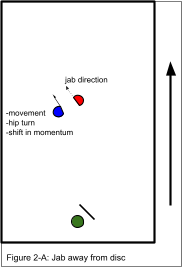
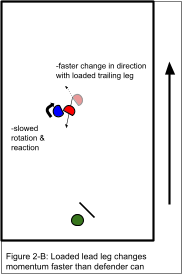
Jab Cut - The jab cut is done by making a jabbing motion typically in a lateral direction to your frontal plane. This creates the illusion of running in that direction, while it also loads your leg to push and move in the opposite direction. In this move you are trying to exploit your defender’s tendency to (over)react to your movement and put them in a weak-reaction state. As a result it is important to think about the purpose and placement of your jab in terms of your defender.
Placement of the jab (especially the 45-degree jab) with respect to the outside foot of your opponent is also important. A placement outside the space between the defender’s feet (footbox) will likely create a drop-step or a hip-turn. A placement inside the footbox will likely create a backpedal.
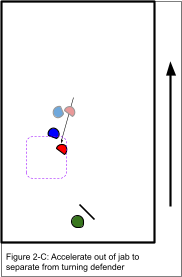
The last, most important component of the jab step is the acceleration out of the step. It is your acceleration out of the jab that creates a majority of your separation. The jab is simply reducing the reaction of your defender, allowing you to start your acceleration before they can react. Loading your jab foot properly, and being able to generate force from that in the desired direction allows you to get separation from your defender.
Here are some examples of a jab cut:
![]()
![]()
![]()
A note about the last cut: it isn't very effective. The cutter gets open, and gets the disc, but because they are in front of their defender their jab didn't really change the defender's reaction before motion. In the first two the jab is perpendicular to the defender's frontal plane (first video is into the frontal plane and the second video is away) causing the defender to generate momentum perpendicular to their frontal plane and in the wrong direction.
This one shows a double-jab (which is still a jab) more parallel to the frontal plane of the defender and causing a hip-turn.
![]()
Jab Cut - The jab cut is done by making a jabbing motion typically in a lateral direction to your frontal plane. This creates the illusion of running in that direction, while it also loads your leg to push and move in the opposite direction. In this move you are trying to exploit your defender’s tendency to (over)react to your movement and put them in a weak-reaction state. As a result it is important to think about the purpose and placement of your jab in terms of your defender.
- A jab is meant to generate a hip-turn, pause, or weight-shift by your defender.
- A jab towards the frontal plane of your defender will possibly generate a back-step.
- A jab along the frontal plane of your defender may generate a hip turn, but it also might cause the defender to shuffle and maintain their positioning.
- A jab at a 45 degree angle to their frontal plane (an attacking jab) will force a clear hip turn. At worst, assuming the defender absorbs it well, it will generate a hop backwards.
Placement of the jab (especially the 45-degree jab) with respect to the outside foot of your opponent is also important. A placement outside the space between the defender’s feet (footbox) will likely create a drop-step or a hip-turn. A placement inside the footbox will likely create a backpedal.
The last, most important component of the jab step is the acceleration out of the step. It is your acceleration out of the jab that creates a majority of your separation. The jab is simply reducing the reaction of your defender, allowing you to start your acceleration before they can react. Loading your jab foot properly, and being able to generate force from that in the desired direction allows you to get separation from your defender.
A note about the last cut: it isn't very effective. The cutter gets open, and gets the disc, but because they are in front of their defender their jab didn't really change the defender's reaction before motion. In the first two the jab is perpendicular to the defender's frontal plane (first video is into the frontal plane and the second video is away) causing the defender to generate momentum perpendicular to their frontal plane and in the wrong direction.
This one shows a double-jab (which is still a jab) more parallel to the frontal plane of the defender and causing a hip-turn.
Monday, February 15, 2016
The Cutting Tree: Introduction
A few years ago, on Skyd, Mike "MC" Caldwell wrote an article titled "The Cutting Tree." My excitement was through the roof, as the implied cutting tree surely was like a football cutting tree and it would not only allow for common vernacular but be a coaching tool that could truly improve youth development. I wrote a post about it then and mentioned that Kyle and I would be working on something. Well, two years have passed and while I haven't been working on that exclusively, I have made some progress and think it is time to start putting this out. So here is a rough introduction to what will hopefully be a discussion about cutting as a skill.
And that is that. There are nine sections to the tree. Currently I am going through video trying to find more examples of each cut. Diagrams and descriptions are mostly written, and might end up here in a piecemeal fashion. At some point I will probably get Ultiworld to publish it if I think it is ready. By no means am I doing this alone. Kyle Weisbrod, Miranda Knowles, Jason Simpson and Andy Loveseth have all been asked for their opinions and their contributions have been incredibly informative. Originally the "tree" was a scattered mess, which is exactly the opposite of its purpose. Also I need to thank my wife for proof-reading this and helping me not sound like an idiot despite my best efforts.
Welcome to the Cutting Tree. This is an attempt to codify a language for cutting so that coaches can better develop training programs to create superior cutters. One problem that slows development in our sport is that we often lack a common language set, especially across regions. This leads to lost time as players/coaches have to explain what they mean to each other before real understanding can be achieved. Think of the number of times you have drawn out what a “question mark cut” is to another player.
That said, here's what this is not. I am not advocating for teams to lose their special vernacular. Calling an upline cut a beta, shooter or power cut is fine. But I think being able to trace those names back to a common motion helps development. Additionally, this is by no means a tutorial for how to cut effectively. That will take tons of practice using methodologies that are not described here. Rather the following is a set of practicable tools that a cutter can use on the way to being more effective.
First we should define “cut” for the sake of this article. From here on when I refer to a “cut” I am talking about a specific pattern of movement (feet, legs and momentum) designed to get separation from a defender. All of these cuts will not get the same type of separation in all different situations and against different styles of defense. But the purpose of developing this language is so that we (as coaches) can more easily discuss movement against a defender and what type of cuts make sense in a particular offensive scheme or situation.
There is a tendency while reading this to want to refer to particular, situational cuts. Above, the “up line” cut was referenced as an example even though it doesn't fi our criteria for a "cut." The “up line” cut is not mentioned again in this document because it is situational (the location of the disc, offender and force are required). Instead the following breaks down and names the possible ways to execute an upline cut. You might gain separation from your defender using the same method for different situational cuts (continuation, scoring, etc.). The hope is that by naming these methods for gaining separation we might also be able to better train the right method for the right situation (something that is already done at many clinics and in many huddles).
There are a total of 9 different cuts described here. The differences in the cuts are at times minimal, and one could argue that some of them should be collapsed into one cut. On the other hand some would argue that there are other cuts that aren’t described in this document that should be included. Both stances are correct on some level, but it is important to remember that this isn’t a definitive guide but rather the start of a conversation.
Here are the 9 cuts:
1 - Straight Cut
2 - Jab Cut
3 - Check Cut
4 - Double Cut
5 - Press Cut
6 - Seal Cut
7 - Elbow Cut
8 - Slice Cut
9 - Cross CutAnd that is that. There are nine sections to the tree. Currently I am going through video trying to find more examples of each cut. Diagrams and descriptions are mostly written, and might end up here in a piecemeal fashion. At some point I will probably get Ultiworld to publish it if I think it is ready. By no means am I doing this alone. Kyle Weisbrod, Miranda Knowles, Jason Simpson and Andy Loveseth have all been asked for their opinions and their contributions have been incredibly informative. Originally the "tree" was a scattered mess, which is exactly the opposite of its purpose. Also I need to thank my wife for proof-reading this and helping me not sound like an idiot despite my best efforts.
Tuesday, August 04, 2015
Gender Contact Ratio (two years later)
So we had another cycle of U23 mixed. We won gold again, but didn't win the spirit award. Two years ago I put down some numbers regarding the number of touches our women had compared to our opponents in the finals (Canada). I figured I would run some of the same numbers to see how we "did" this time.
Anecdotally I felt like we used our women well this cycle, perhaps as well as we did in 2013. While we had fewer women around the disc (Claudia, Sophie and Tash in 2013 and only Q and Clare in 2015) we did a great job having more effective female cutters downfield. Also the finals were significantly less windy than in 2013, which gave us more confidence in throwing to our women. I can't remember a single instance of a woman missing a pass and not getting thrown to next time we were open. It is something that our team focuses on (putting people in places to succeed and giving them that chance when it is there) and both cycles really delivered on it.
In contrast the Aussies were running a different offensive style that was better suited for mixed exploitation (in that it used the fact that there were different genders on the field better) but used the women less.
Let's see how the numbers look. There were 252 points of contact (catches) for USX and of that 62 were by women. That breaks down to about 25% and is therefore a contact ratio of 3:1. So for every contact by a woman there were three by a man. The Australians had 118 points of contact with only 15 by women. That is a very low 13% or a 8:1 contact ratio. We also noted that of our 17 goals, 13 were on possessions where a woman touched the disc, 4 were caught by women and 6 were thrown by women.
We also noted that it took us 34 possessions to score 17 goals (exactly a 2.00 Possessions Per Goal that I felt indicated the difference between elite and good college teams) while the Bluebottles (which is apparently a jellyfish) scored 4 out of 33 possessions.
Again, I have no idea what any of this means. I think Australia's success (which I guess I should write about at some point) shows that a more balanced contact ratio doesn't necessarily indicate success. But one of our goals was to use our women to win games and these numbers feels like they support that.
Of interesting note, our contact ratio is actually worse than it was in 2013. I feel like much of that is due to the occasional use of a 4-2-1 wall zone defense by the Australians. Canada played almost exclusively man in 2013, and while zone defense did allow Q more touches, that was only on the lines where she was on the field. There were two points where we didn't have a line conducive to female handling on the field against their softer zone. Those points involved a ton of short passes between un-marked men for basically zero yards. Looking at the touches during those points there were 82 touches but only 16 were by women (leading to a ratio of 33:8 or 4.125:1). Removing those points from the previous data leads to a contact ratio of 2.7:1.
Anecdotally I felt like we used our women well this cycle, perhaps as well as we did in 2013. While we had fewer women around the disc (Claudia, Sophie and Tash in 2013 and only Q and Clare in 2015) we did a great job having more effective female cutters downfield. Also the finals were significantly less windy than in 2013, which gave us more confidence in throwing to our women. I can't remember a single instance of a woman missing a pass and not getting thrown to next time we were open. It is something that our team focuses on (putting people in places to succeed and giving them that chance when it is there) and both cycles really delivered on it.
In contrast the Aussies were running a different offensive style that was better suited for mixed exploitation (in that it used the fact that there were different genders on the field better) but used the women less.
Let's see how the numbers look. There were 252 points of contact (catches) for USX and of that 62 were by women. That breaks down to about 25% and is therefore a contact ratio of 3:1. So for every contact by a woman there were three by a man. The Australians had 118 points of contact with only 15 by women. That is a very low 13% or a 8:1 contact ratio. We also noted that of our 17 goals, 13 were on possessions where a woman touched the disc, 4 were caught by women and 6 were thrown by women.
We also noted that it took us 34 possessions to score 17 goals (exactly a 2.00 Possessions Per Goal that I felt indicated the difference between elite and good college teams) while the Bluebottles (which is apparently a jellyfish) scored 4 out of 33 possessions.
Again, I have no idea what any of this means. I think Australia's success (which I guess I should write about at some point) shows that a more balanced contact ratio doesn't necessarily indicate success. But one of our goals was to use our women to win games and these numbers feels like they support that.
Of interesting note, our contact ratio is actually worse than it was in 2013. I feel like much of that is due to the occasional use of a 4-2-1 wall zone defense by the Australians. Canada played almost exclusively man in 2013, and while zone defense did allow Q more touches, that was only on the lines where she was on the field. There were two points where we didn't have a line conducive to female handling on the field against their softer zone. Those points involved a ton of short passes between un-marked men for basically zero yards. Looking at the touches during those points there were 82 touches but only 16 were by women (leading to a ratio of 33:8 or 4.125:1). Removing those points from the previous data leads to a contact ratio of 2.7:1.
Subscribe to:
Posts (Atom)