In my recent travels through the blogosphere, I’ve noticed a trend to argue for possession based offenses and the threat they pose to top teams. In a sense, I definitely agree and I think you can perhaps point to Jam’s recent loss to Kaos and the Condors’ Labor Day loss to Rhino as possible examples of this. However, I think that newer players reading our blogs could be getting a bad impression of the huck. I also think we do a disservice to both our opponents and ourselves when we assume that the west coast teams are beating up on us simply because they have more Big Dumb Athletes (BDA) than we do.
When a team chooses the path of the huck they’ve chosen to be the aggressor. They’re taking it to the opponent saying, “we’re crazy and you better keep an eye on your end zone because the disc could be going there at any moment.”
It should be noted that the preachers of possession are not opposed to the huck. They have argued many times that the best pass is not necessarily the one with the least risk, but rather the pass that gives your team the highest percentage chance of scoring (I thought that might be too difficult of a calculation for most players to make - here). I think Parinella wrote that a huck with 60% completion rate is good enough in most scenarios (although I can’t seem to find it at the moment, so perhaps I’m making that up). I assume this number was based purely on “the numbers.” In other words, type .90 * .90 into your calculator and start hitting = it doesn’t take long for that number to be lower than .60. I’m arguing that the advantageous implications of the huck extend beyond the calculation of giving your team the highest percentage chance of scoring (this goal).
When a team completes a huck it has a psychological effect on the opponent. I try to make it a point to catch a huck in the first few points of the game because it really puts The Fear into a defender. No one likes to be scored on and there is something especially intimidating about getting taken to the rack. A confident defender won’t let it affect the way he plays defense, but often times a defender becomes so afraid of the deep game that he concedes the underneath. It also the case, that an incomplete huck is sometimes just as effective as opening up the underneath as a completed one. “this team is crazy – they’ll throw ANYTHING deep, I was beat on that last one, good thing the throw sucked. I’m not gonna give him a chance to beat me again.” In a sense, this is similar to Mooney’s discussion of using the 1-3-3, the defense that never works. The early no conscience huck trades short term efficiency for greater long term efficiency. In other words, this goal may be more difficult to score, but later goals will be easier to score if the opponent is afraid of the deep shot.
None of this even takes into account the “oops, we scored” factor of the huck. The fact is that terrible throws often times work out on the big away cut. The most compelling reason I’ve heard for this is Parinella’s discussion of temporal vs. spatial margins. A huck thrown at the correct moment has a huge spatial margin for error. When your BDA says, “just throw me ANYTHING in bounds,” he’s actually stumbled onto something.
Most games favor the side that is willing to be aggressive and ultimate is not really much different.
That’s about all I got on that, but here’s a digression into an alternate theory as to why the top aggressive teams may be susceptible to the possession based strategy. I actually think it’s the defensive strategy of the aggressive teams that is more vulnerable than the offensive strategy. I think you can fairly classify 6 of 8 of last year’s quarterfinalists as aggressive (no conscience hucking) teams. It’s not too surprising then that the defenses on these teams have evolved to stop the huck. The strategies that are most effective at stopping the huck (flat marking, backing downfield cutters) also happen to be particularly ineffective against a traditional dump-swing straight stack approach. If the aggressive teams do not make the necessary defensive adjustments, I think they are vulnerable to an efficient possession based team.
Friday, September 23, 2005


Tuesday, September 20, 2005
Obligatory Sectionals Report
I’ve been insanely busy the last couple of weeks and I’m behind on my blog reading/writing. There are several recent additions to what blogosphere (I think we should all start using Luke’s term to avoid embarrassing situations like Parinella calling it Blogworld) I didn’t realize existed. Idris seems to be trying to maintain some semblance of order with his ultimatetalk.com. Our blog has to be particularly annoying to catalogue since it has multiple authors. Meanwhile, it appears that we’ll hit the 15,000 visit mark sometime this morning – not too bad for a blog that was just two guys talking to each other about frisbee. Recent posts have kind of gone astray from our original intent of talking about coaching and strategy. With the college season starting up again, I’m more focused on that kind of stuff and will probably start posting more strategy/coaching after the club season. Speaking of which, I’m going with Chain 15 DoG 3 in the finals of nationals…I believe they’re taking bets over on the Frisbee Spew Site, so get your money in now. On to the obligatory sectionals report…
Chain was first formed in 1981 (making Chain older than half the guys on our team) and has never lost a game at sectionals. With all the complaining that the DoG guys do, I thought perhaps they could understand how painful sectionals is, but then I realized they played Twisted Metal, and as such, they have absolutely no idea. This year was particularly bad as the traditional second team in our section, Tanasi, has gone coed. In the past, we’ve tried many gimmicks to try to force people to play seriously. One year we instituted the if you turn it over your benched rule. That was scrapped after a few points when it became clear that people were turning it over intentionally. Last year we flipped the script and made the rule if you turn it over you play for the rest of the game, and that was actually pretty effective. This year, with the Hammonds in charge, we brought out the alcohol. The rule was – if you turn it over you’ve got to buy the beer. This led to some pretty funny scenarios. In our second game a rookie was cutting in at full speed for Jay Hammond (easily the most obnoxious guy in ultimate) and Jay just absolutely fires the flick at him from like 7 or 8 yards as he turning to clear. Of course, the sideline is all over the poor guy when he can’t come up with the catch. At this point, it might make sense to note that if you’re thinking of modeling your team after Chain….it’s probably not the best idea. I was kind of afraid that some of our opponents would be insulted by our drinking/goofing off, but for the most part our opponents bought into the idea of a fun game and started showboating as well. We somehow get through pool play with no injuries and a 4-0 record.
We had to come back out on Sunday for the finals and we actually took the game pretty seriously and played hard. The one play of note came late in the game after we had caught a huck and called timeout on the goal line. We have this 16 year old Paideian, George Stubbs, that’s playing with us, and he’s been talking about this end zone play all year. Basically, you have a guy run off the back of the stack to the front cone, the thrower fakes the throw, the cutter makes the huge dive and the sideline and stack go nuts like the guy just made an incredible catch. Meanwhile, another cutter sneaks off to the other cone to catch the goal. So everything is going according to plan, George comes off the back with the HUGE layout, everyone goes nuts and their whole team turns to watch. Then my defender starts screaming, “Boston Surprise!” “Boston Surprise!” and sprints over to the break side fast enough to stop the goal. Of course, being alone in the middle of the end zone it might have made sense for me to say something, but instead I stood there amazed. I’ve never heard of this play and I certainly didn’t know what its name was. But this guy, 1)has heard of the play 2) recognized it as soon as he saw the guy layout 3)had enough presence of mind to sprint back over to the break side to stop the play 4)all the while yelling Boston Surprise! Boston Surprise! alerting his team to our evil plan. Crazy. I would have asked him to play with Chain, but he’s obviously way too intelligent.
Anyway, that’s about all I got.
Chain was first formed in 1981 (making Chain older than half the guys on our team) and has never lost a game at sectionals. With all the complaining that the DoG guys do, I thought perhaps they could understand how painful sectionals is, but then I realized they played Twisted Metal, and as such, they have absolutely no idea. This year was particularly bad as the traditional second team in our section, Tanasi, has gone coed. In the past, we’ve tried many gimmicks to try to force people to play seriously. One year we instituted the if you turn it over your benched rule. That was scrapped after a few points when it became clear that people were turning it over intentionally. Last year we flipped the script and made the rule if you turn it over you play for the rest of the game, and that was actually pretty effective. This year, with the Hammonds in charge, we brought out the alcohol. The rule was – if you turn it over you’ve got to buy the beer. This led to some pretty funny scenarios. In our second game a rookie was cutting in at full speed for Jay Hammond (easily the most obnoxious guy in ultimate) and Jay just absolutely fires the flick at him from like 7 or 8 yards as he turning to clear. Of course, the sideline is all over the poor guy when he can’t come up with the catch. At this point, it might make sense to note that if you’re thinking of modeling your team after Chain….it’s probably not the best idea. I was kind of afraid that some of our opponents would be insulted by our drinking/goofing off, but for the most part our opponents bought into the idea of a fun game and started showboating as well. We somehow get through pool play with no injuries and a 4-0 record.
We had to come back out on Sunday for the finals and we actually took the game pretty seriously and played hard. The one play of note came late in the game after we had caught a huck and called timeout on the goal line. We have this 16 year old Paideian, George Stubbs, that’s playing with us, and he’s been talking about this end zone play all year. Basically, you have a guy run off the back of the stack to the front cone, the thrower fakes the throw, the cutter makes the huge dive and the sideline and stack go nuts like the guy just made an incredible catch. Meanwhile, another cutter sneaks off to the other cone to catch the goal. So everything is going according to plan, George comes off the back with the HUGE layout, everyone goes nuts and their whole team turns to watch. Then my defender starts screaming, “Boston Surprise!” “Boston Surprise!” and sprints over to the break side fast enough to stop the goal. Of course, being alone in the middle of the end zone it might have made sense for me to say something, but instead I stood there amazed. I’ve never heard of this play and I certainly didn’t know what its name was. But this guy, 1)has heard of the play 2) recognized it as soon as he saw the guy layout 3)had enough presence of mind to sprint back over to the break side to stop the play 4)all the while yelling Boston Surprise! Boston Surprise! alerting his team to our evil plan. Crazy. I would have asked him to play with Chain, but he’s obviously way too intelligent.
Anyway, that’s about all I got.
Friday, September 09, 2005
Kangaroo vs Synthetic
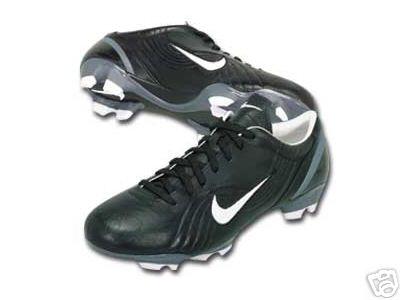 There are way too many posts on rsd and on blogs about cleats. Here's mine... I read a comment over on Frisbee Spew where Heacox says he prefers the synthetic uppers they are putting on cleats these days. During Summer League EOS, AJ trots out with his new cleats and shows them off. "Kangaroo," he says. Here is a gratuitous shot of AJ modeling his Puma Kings. AJ and I agree on one thing, coed sucks...no, wait. Kangaroo is King. The comfort scale in cleats goes like this (worst-best): synthetic, cow leather, and kangaroo leather.
I remember the first kangaroo leather cleats I got, some Adidas TRX 3's. I couldn't believe how good they felt. Then, of course, Adidas stopped making them. I switched to the Nike Talaria's, after hearing how amazing they were, and I was won over (not saying much since Adidas stopped making my beloved TRX 3's). I loved the traction I got and how light they felt. My feet paid the price though, as I started getting blisters and blackened toenails again. The Talaria's used Nike's synthetic upper, but I'd always had problems with Nike's so I just attributed it to that.
The Talaria's synthetic upper ripped after 3 tournaments. Thankfully, Nike has a great return policy. If your shoes tear or malfunction, within 3 years of their manufacture, Nike will 'replace' them. Generally this means they'll give you the MSRP of the cleats in the form of a Niketown.com gift certificate. Unfortunately, it takes a while to ship them there, have them inspect them, get the gift certificate, order the new cleats (hoping they have them online), and have them shipped. Regionals was coming up and I needed new cleats. I ended up getting lucky, I found a pair of Nike Mercurial Vapor K's. Basically the same shoe, but made from juicy Kangaroos. Gone are the blisters and the blackened toes. They've lasted longer than the Talarias too. The kangaroo stretches, which makes them more comfortable and durable than the synthetics. They are slightly heavier (.6 ounces), and a bitch to find though. I only wear mine at tournaments (I have an unlimited supply of Talarias from Nike for practice), and they're still going strong. I just bought a backup pair off Ebay.
Most of Adidas top-of-the-line cleats seem to be kangaroo, but Nike (and Gaia) seems to be sticking with the synthetics. I'm sure the Mercurial Vapors, Vapor TDs, Speed TDs, Super Speed Ds, Vapor Jet TDs and Total 90 IIIs are great and all, but I'll stick with my Mercurial Vapor Ks (if only to help the kangaroo population problem.)
Tuesday, September 06, 2005
Confidence
I've got a few players who are currently having confidence problems. They've either had a run of bad luck, or made a few bad plays in a row and suddenly it gets in their heads. I'm trying to decide the best way to handle the situation. It's likely different for every player, but the way I see it you've got two basic ways to handle the situation. You can keep putting them in tough situations, situations they are currently having problems with, to show them that you have faith in them. Or, you can put them in situations they are more comfortable with and allow their confidence to return before putting them back in a situation they are having problems with.
I remember several years ago in summer league, I had back to back games where I had a key turnover late in the game. It got in my head so much that I didn't even want to be on the field. My captain at the time took me aside and told very nicely to get over it, that the team was going to need me playing to succeed, etc. It encouraged me to get back on the 'horse', and eventually I regained my confidence. I think an important part of it was that someone I respected showed they had confidence in me.
Does anyone else have any experiences with players (or yourself) having confidence issues?
I remember several years ago in summer league, I had back to back games where I had a key turnover late in the game. It got in my head so much that I didn't even want to be on the field. My captain at the time took me aside and told very nicely to get over it, that the team was going to need me playing to succeed, etc. It encouraged me to get back on the 'horse', and eventually I regained my confidence. I think an important part of it was that someone I respected showed they had confidence in me.
Does anyone else have any experiences with players (or yourself) having confidence issues?
The Numbers Game
This weekend we were trying to figure out what jersey number yields the best team. In other words you take all of the 1’s on all of the teams and you put them all on the same team, all of the 2’s make another team, etc. – what number has the best team? Here are last year’s Championship Rosters for reference. It’s also kind of fun that certain types of players tend to gravitate to certain numbers. I’m not really sure what team would be best. The big ego 1’s have a strong squad, but have self-destruct written all over them. The 9’s have the deepest squad, drawing a player from every champies team. The 3’s and 7’s also have strong squads. Sadly, the 31’s only had 1 player at Nationals last year, but there's always next year.
Subscribe to:
Posts (Atom)